Evidence-based response
What Are the Hidden Risks of Gut Bacteria Tests? Evidence-Based Answer Without the Hype
The main risks of consumer gut bacteria tests are overinterpretation, privacy exposure, unnecessary products, anxiety, and delayed care, not the stool sample.
By Sandra McKenzy, Pharmacist · 2026-06-03
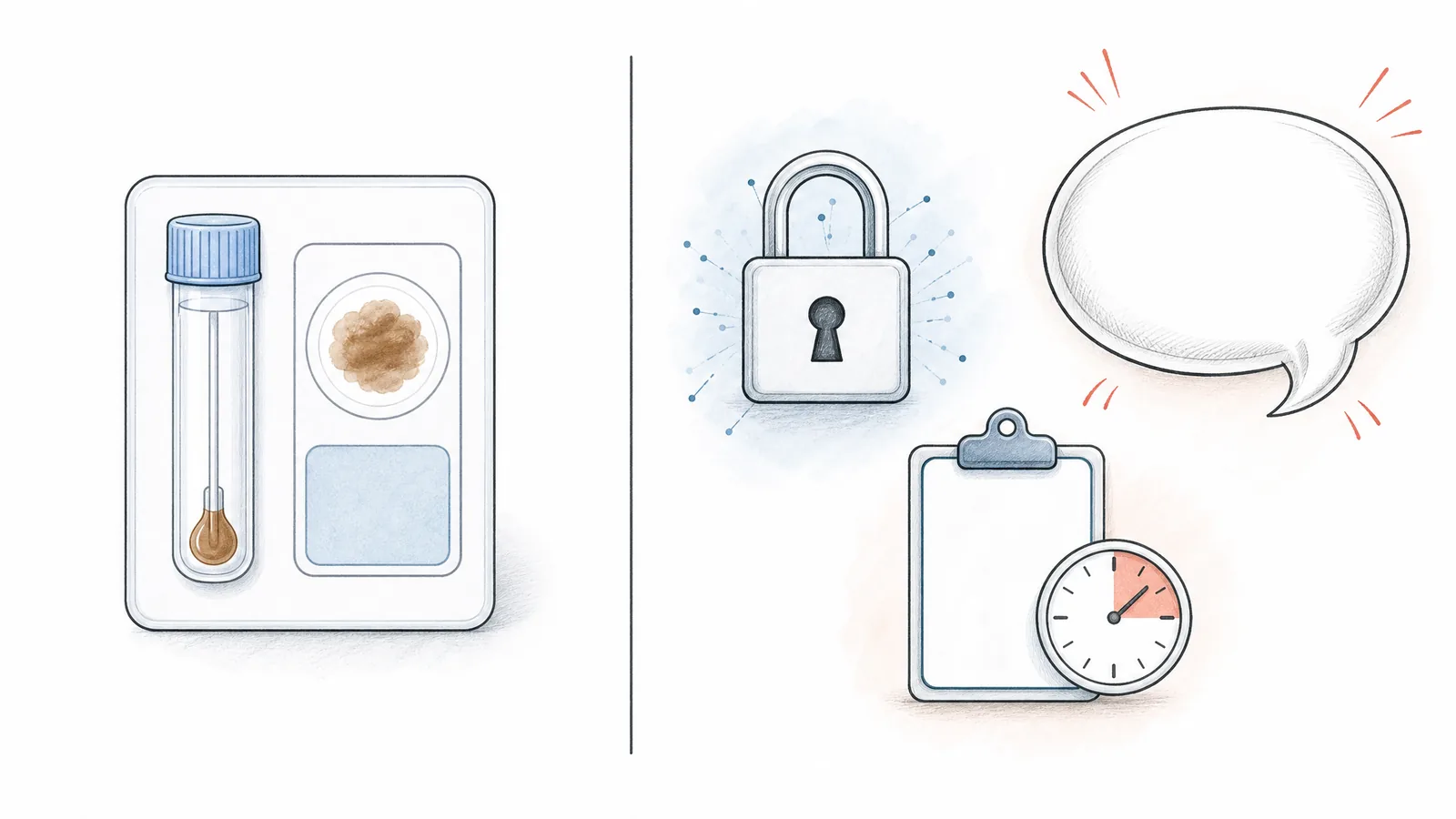
Short answer: Collecting a stool sample for a microbiome test is usually physically low risk, but the real risks are interpretation, privacy, anxiety, unnecessary supplements, and delayed medical care. The result can look precise while the clinical meaning remains uncertain.
Are there physical risks in gut microbiome testing?
For most adults, the sample collection itself is not invasive. The bigger safety issue begins after the report arrives. A person may overreact to a low abundance score, label normal variation as disease, buy unnecessary products, or postpone proper evaluation because a consumer report feels more personalized than standard medicine.
Evidence summary
- The stool sample is usually low risk, but interpretation can create harm.
- Microbiome data are personal biological data and need serious privacy protection.
- Single-sample results can vary with diet, timing, stool consistency, illness, and methodology.
- Consumer reports should not replace tests for bleeding, infection, inflammation, or malabsorption.
- Risk rises when companies turn uncertain associations into treatment recommendations.
Can a microbiome result be misleading?
Yes. Many reports compare a person with a reference database and translate differences into wellness language. That can be useful for education, but it can also overstate certainty. There is no universal healthy microbiome range that applies equally across populations, diets, medications, geography, and sequencing platforms.
What about privacy and data use?
Microbiome data can reveal health-adjacent information about diet, geography, medication exposure, household sharing, and sometimes pathogen or resistance patterns. Consumers should know who stores the data, whether it is shared for research or commercial purposes, how long it is retained, and whether deletion is possible.
What marketing gets wrong
Some marketing frames testing as a safe shortcut to control. The safer framing is more modest: a microbiome test can be one source of biological information, but interpretation should not outrun clinical validation.
When should you see a clinician instead?
Do not rely on a consumer report if you have blood in stool, weight loss, fever, persistent diarrhea, severe or worsening pain, anemia, dehydration, immune suppression, recent antibiotics with severe symptoms, or symptoms after travel.
Bottom line
The hidden risks are mostly downstream: false reassurance, false alarm, privacy exposure, and delayed care. A careful test provider should make those limits visible before selling recommendations.
What are the practical risks of gut bacteria testing?
The physical risk of collecting a stool sample at home is usually low. The larger risks are interpretive. A report may label common variation as dysbiosis, imply that a symptom has been explained, or recommend supplements and diets that have not been clinically validated for the individual. This can delay appropriate care when symptoms actually need targeted testing for inflammation, infection, bleeding, malabsorption, celiac disease, medication effects, or other causes.
There is also a psychological risk. People may focus on a single low bacterium, a low diversity score, or a red warning color without knowing how stable that marker is or whether it predicts anything meaningful. Microbiome data can feel precise because it contains many numbers. Precision in a report is not the same as clinical certainty.
What privacy questions matter?
Stool microbiome data is biological data. It may reveal diet patterns, medication exposure, possible travel-related organisms, and other health-adjacent information. Before ordering a test, readers should check who owns the data, whether samples are stored, whether de-identified data may be used for research or commercial development, how long records are retained, and whether deletion is possible. Clear consent matters because microbiome datasets can become more informative as science advances.
When can testing still be reasonable?
Testing can be reasonable when expectations are modest. A person may want educational insight into dietary patterns, broad microbial diversity, or changes over time after a defined lifestyle shift. It may also support research participation. The safe framing is that results are conversation starters. They are not proof that a person needs antimicrobials, probiotics, restrictive diets, detox protocols, or repeated testing.
The best protective step is to separate curiosity from medical necessity. If the goal is to understand a health symptom, start with the symptom, severity, duration, medications, and red flags. Then choose the test that answers that clinical question. Sometimes that will be a microbiome profile. Often it will not.
What a cautious evidence-based answer looks like
A cautious answer does not dismiss microbiome science. It separates established biology from clinical promises. Established biology can say that microbial communities interact with diet, immune signaling, metabolites, medications, and intestinal barrier function. Clinical promises need more. They need studies showing that a specific test or intervention improves a specific outcome for a defined group of people. Without that bridge, the correct wording is possible, plausible, associated, or still being studied.
For readers, this wording is not academic nitpicking. It protects decisions. If a claim is only plausible, it may still support general habits such as eating enough fiber, avoiding unnecessary antibiotics, sleeping well, and discussing persistent symptoms with a clinician. It should not be used to self-diagnose disease, stop prescribed medication, start antimicrobial protocols, or ignore red flags.
The same caution applies to repeat testing. Repeating a broad microbiome profile can be useful in research or carefully planned tracking, but frequent retesting without a clinical question can create noise and unnecessary worry.
Evidence notes
- Gut microbiome as a clinical tool in gastrointestinal disease management: are we there yet?. Nature Reviews Gastroenterology & Hepatology. 10.1038/nrgastro.2017.29
- Translating microbiota analysis for clinical applications. Nature Microbiology. 10.1038/s44222-024-00168-3
- Credible inferences in microbiome research: ensuring rigour, reproducibility and relevance in the era of AI. Nature Reviews Gastroenterology & Hepatology. 10.1038/s41575-025-01100-9
- Regional variation limits applications of healthy gut microbiome reference ranges and disease models. Nature Medicine. 10.1038/s41591-018-0164-x
- Temporal variability in quantitative human gut microbiome profiles and implications for clinical research. Nature Communications. 10.1038/s41467-021-27098-7
- Stability of the human faecal microbiome in a cohort of adult men. Nature Microbiology. 10.1038/s41564-017-0096-0
- Faecal quality control. Nature Microbiology. 10.1038/s41564-019-0535-1
This article is educational and does not diagnose, treat, or replace care from a qualified clinician.