Evidence-based response
7 Signs Your Microbiome Lacks Diversity: What Science Actually Says
Common symptoms can overlap with microbiome changes, but no symptom checklist can diagnose low diversity or replace clinical evaluation.
By Sandra McKenzy, Pharmacist · 2026-05-31
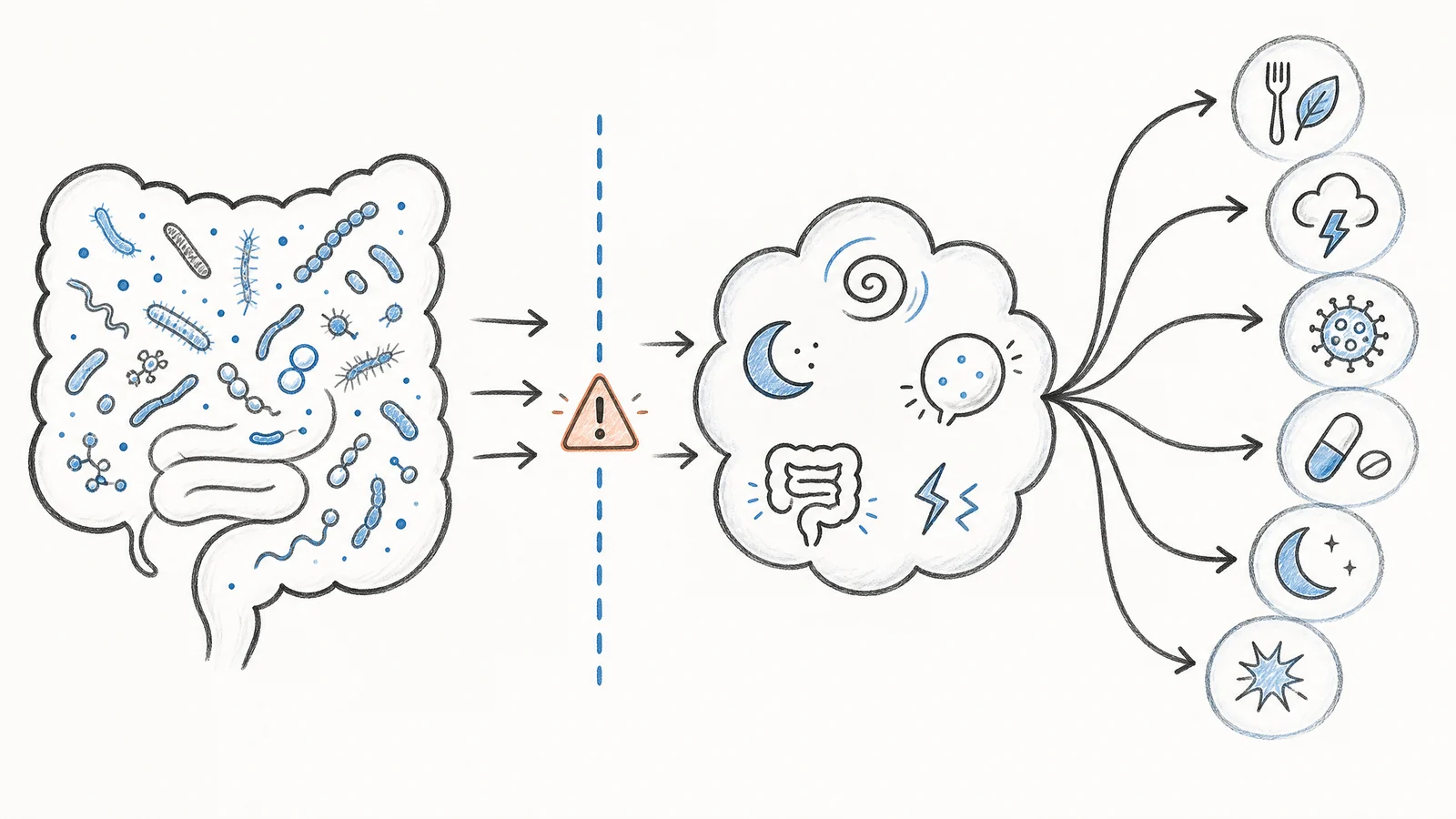
Short answer: There are no seven symptoms that prove your microbiome lacks diversity. Persistent bloating, irregular stools, post-antibiotic digestive changes, skin flares, allergies, fatigue, brain fog, or low mood can overlap with microbiome disruption, but they are nonspecific. Low diversity is a research signal and sometimes a risk marker, not a standalone diagnosis. Symptoms should guide sensible care, not self-diagnosis from a checklist.
Can symptoms tell you that your microbiome lacks diversity?
Symptoms can tell you something is worth paying attention to. They cannot reliably tell you that gut microbial diversity is low. The same symptom can have many causes. Bloating may reflect rapid eating, constipation, lactose intolerance, high-FODMAP foods, irritable bowel syndrome, small intestinal bacterial overgrowth, celiac disease, medication effects, or stress-related motility changes. A diversity score is only one layer of the picture.
The source article correctly warns that symptoms alone are imperfect, but it still frames common symptoms as signs of low diversity. That is where readers need caution. Low diversity is associated with several diseases and exposures in research, including antibiotics, inflammatory bowel disease, recurrent Clostridioides difficile infection, some metabolic conditions, and parts of the gut-brain literature. It is not a symptom-based diagnosis that can be read from daily discomfort.
What does low microbiome diversity actually mean?
Microbiome diversity usually refers to richness, meaning how many different organisms are detected, and evenness, meaning how balanced their distribution is. In general, a diverse ecosystem may have more functional redundancy. More microbes can share tasks such as fermenting fiber, producing short-chain fatty acids, modifying bile acids, resisting opportunistic organisms, and interacting with immune pathways.
But higher diversity is not always automatically better in every context, and lower diversity does not identify one disease. The clinical meaning depends on the person, sample type, methods, diet, geography, medications, and symptoms. A single stool sample is a snapshot, not a full map of the gut.
Evidence summary
- Low microbial diversity is associated with several conditions, but it is not specific enough to diagnose a cause of symptoms.
- Functional gastrointestinal symptoms can overlap with dysbiosis, yet many non-microbial causes produce the same complaints.
- Diet, antibiotics, geography, medications, and disease state can all influence diversity metrics.
- High-fiber and fermented-food interventions can affect microbiome and immune markers, but responses vary by person.
- Red flags such as bleeding, anemia, weight loss, fever, or nighttime diarrhea need clinical evaluation first.
Are bloating, gas, or irregular stools signs of low diversity?
They can be compatible with microbiome changes, but they are not proof. Studies in functional gastrointestinal disorders have reported microbial differences in some groups. However, symptoms like bloating and altered bowel habits are common and multifactorial. They can arise from motility, visceral sensitivity, food intolerances, pelvic floor dysfunction, infection, inflammation, or medication effects.
A microbiome test may provide context, especially after antibiotics or major diet change. It should not be used to bypass basic clinical questions: How long has this been happening? Is there pain? Is there diarrhea at night? Is there weight loss, bleeding, fever, anemia, or family history?
Do skin, immune, mood, or brain-fog symptoms prove gut dysbiosis?
No. The gut-skin, gut-immune, and gut-brain axes are real research areas. Microbial metabolites and immune signaling can plausibly influence distant organs. Large cohort work has linked gut microbial patterns with depressive symptoms, and many immune or inflammatory diseases show microbiome differences. But these findings do not mean that eczema, allergies, anxiety, or brain fog can be diagnosed as low diversity without standard evaluation.
This distinction matters because nonspecific symptoms are easy to monetize. A person with fatigue may need sleep assessment, thyroid testing, iron studies, medication review, mental health support, infection evaluation, or other care. A stool diversity score might be interesting, but it should not become the explanation before common causes are checked.
What can help support microbiome diversity safely?
The safest first steps are usually boring and useful: increase plant variety gradually, include fiber-rich foods as tolerated, reduce ultra-processed foods, sleep consistently, move regularly, avoid unnecessary antibiotics, and address chronic stress. Fermented foods and high-fiber diets have human trial evidence for changing microbiome and immune markers, although individual responses vary.
People with IBS, inflammatory bowel disease, eating disorders, severe food restriction, immune suppression, or significant symptoms should personalize changes with qualified help. More fiber is not always immediately better. In some people it needs to be introduced slowly, and in others a low-FODMAP or medically guided approach may be more appropriate for a period of time.
What marketing gets wrong about low diversity
The common overreach is to turn a population-level association into a personal diagnosis. If a group with a disease has lower diversity on average, that does not mean every person with similar symptoms has low diversity, or that raising a diversity score will fix the symptom. Microbiome data are high-dimensional, noisy, and sensitive to methods.
A responsible report should say what is measured, what is uncertain, and what should be discussed with a clinician. It should not imply that seven everyday symptoms are enough to identify a damaged microbiome.
When should symptoms be checked medically?
See a clinician promptly for blood in stool, black stool, unexplained weight loss, anemia, persistent fever, severe or worsening abdominal pain, dehydration, vomiting, nighttime diarrhea, new bowel changes after age 50, family history of colorectal cancer, immune suppression, or persistent diarrhea after antibiotics. Also seek care for severe depression, suicidal thoughts, disabling fatigue, or neurological symptoms. These are not microbiome self-testing situations.
Bottom line
Microbiome diversity matters, but symptom checklists are blunt tools. Common gut, skin, immune, and mood symptoms can coexist with microbiome changes, yet they do not prove low diversity. Treat diversity as one possible clue, not the conclusion. The safest path is to combine symptom context, red-flag screening, evidence-based lifestyle basics, and medical evaluation when symptoms are persistent or concerning.
Evidence notes
- A predictive index for health status using species-level gut microbiome profiling. Nature Communications. 10.1038/s41467-020-18476-8
- Small intestinal microbial dysbiosis underlies symptoms associated with functional gastrointestinal disorders. Nature Communications. 10.1038/s41467-019-09964-7
- The gut microbiome and depressive symptoms across ethnic groups. Nature Communications. 10.1038/s41467-022-34502-3
- Diet-induced extinctions in the gut microbiota compound over generations. Nature. 10.1038/nature16504
- Gut-microbiota-targeted diets modulate human immune status. Cell. 10.1016/j.cell.2021.06.019
- Meta-analysis of gut microbiome studies identifies disease-specific and shared responses. Nature Communications. 10.1038/s41467-017-01973-8
- Regional variation limits applications of healthy gut microbiome reference ranges and disease models. Nature Medicine. 10.1038/s41591-018-0164-x
This article is educational and does not diagnose, treat, or replace care from a qualified clinician.