Evidence-based response
What Are 4 Ways to Take Care of the Digestive System? Evidence-Based Answer Without the Hype
The four best ways to care for digestion are food quality, hydration and movement, sleep and stress support, and testing matched to symptoms.
By Sandra McKenzy, Pharmacist · 2026-06-27
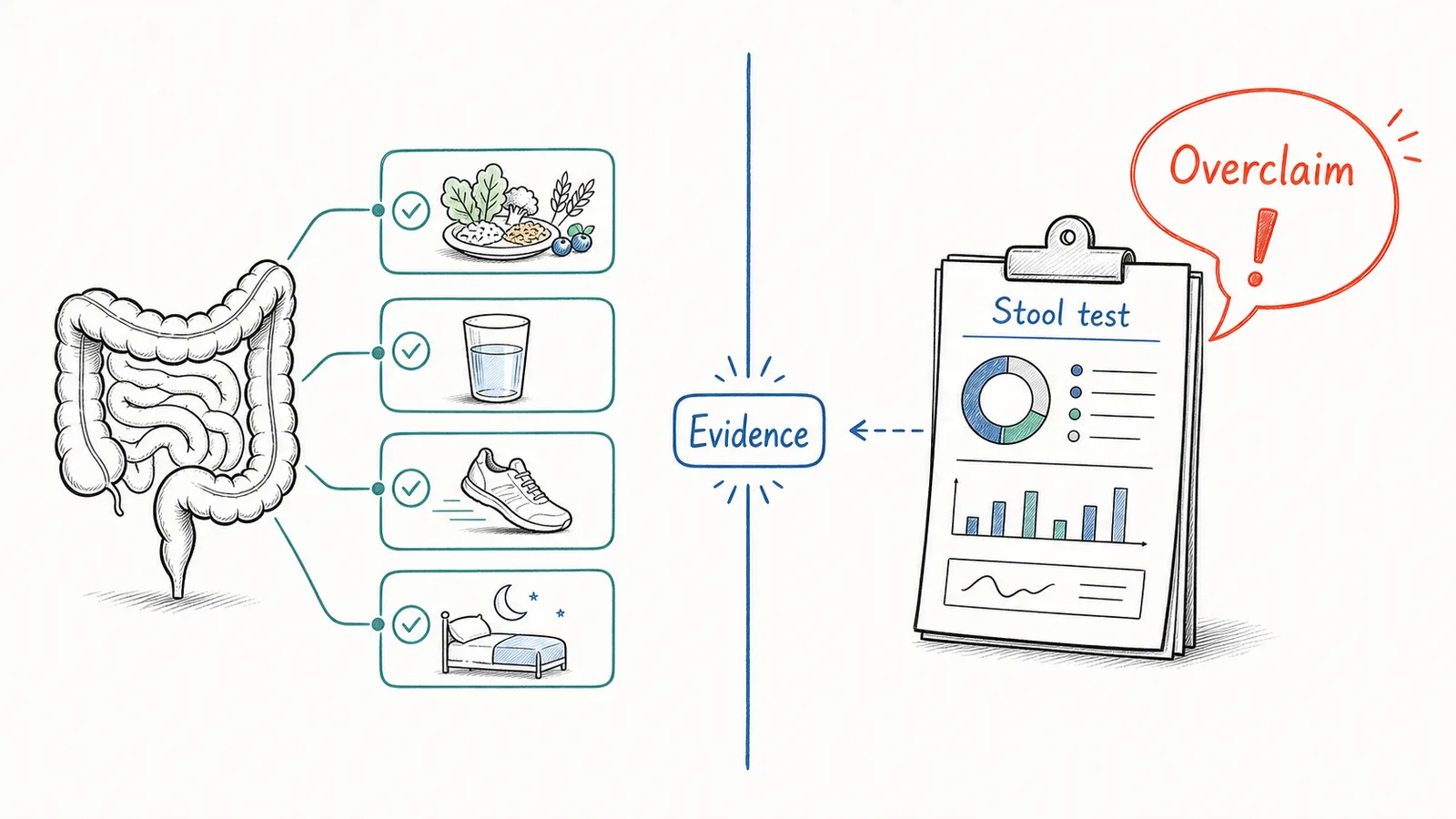
Short answer: Four reliable ways to take care of the digestive system are to eat a fiber-rich, varied diet, stay hydrated and move regularly, protect sleep and stress regulation, and use medical or microbiome testing only when it fits the clinical question. A stool microbiome test can add context, but it is not the foundation of digestive care for everyone.
This evidence-based response addresses a public gut-health article that presents microbiome testing, personalization, diet, supplements, hydration, stress control, and habit optimization as a broad digestive-care plan. The safer answer is simpler and more clinical: start with habits that have broad support, then use testing selectively rather than treating one commercial report as the command center for digestion.
What Are 4 Ways to Take Care of the Digestive System? Evidence-Based Answer Without the Hype
The four most defensible categories are food pattern, fluid and movement rhythm, nervous-system and sleep support, and appropriate clinical evaluation. That does not sound as futuristic as a personalized dashboard, but it is closer to how digestive health works in real life. The gut is influenced by diet, medications, stress, sleep, exercise, infections, immune activity, age, and existing disease. A test can sometimes help frame hypotheses, but it cannot replace that context.
MedicalBrain retrieval for this queue item found several papers that support a cautious, practical answer. The 2026 ISAPP consensus statement defines gut health as a broad state involving digestive comfort, barrier function, immune interaction, host metabolism, and resilience, not a single stool score. Reviews on dietary fiber and short-chain fatty acids explain why plant-rich, fermentable carbohydrates matter for microbial metabolism. Fermented-food consensus work supports possible benefits while warning against treating every fermented food as a guaranteed probiotic therapy. Reviews on clinical microbiome translation make the same point from another angle: microbiome science is promising, but clinical use still needs validation and careful interpretation.
Evidence summary
- Digestive care is best built around food quality, fiber diversity, hydration, movement, sleep, stress regulation, and appropriate medical evaluation.
- Diet strongly affects gut function through both microbiome-dependent and microbiome-independent pathways.
- Fermentable fibers can feed microbial short-chain fatty acid production, but individual responses vary.
- Fermented foods can contribute to diet quality, but they are not automatically equivalent to tested probiotic treatment.
- Consumer microbiome testing can generate hypotheses, but it should not diagnose disease or replace validated clinical tests.
- Red flags such as bleeding, weight loss, fever, anemia, severe pain, dehydration, or persistent night symptoms need clinician assessment.
Way 1: Eat for Gut Function, Not for a Perfect Score
A varied, fiber-rich diet is the most evidence-grounded starting point for ordinary digestive care. Vegetables, legumes, fruit, whole grains, nuts, seeds, and resistant starches provide different fibers and polyphenols. Gut microbes can ferment some of these substrates into short-chain fatty acids such as acetate, propionate, and butyrate. These metabolites are biologically active and are discussed in detail in Nature Reviews Microbiology.
This does not mean more fiber is always better for every person on every day. Someone with active inflammatory bowel disease, bowel obstruction risk, severe constipation, gastroparesis, or irritable bowel syndrome may need a tailored plan. A low-FODMAP diet can reduce IBS symptoms for some patients, yet it can also reduce some beneficial bacteria if followed too strictly or too long. The practical rule is to increase fiber gradually, diversify plant foods when tolerated, and treat symptom flares as a reason to individualize rather than force a wellness rule.
Marketing often turns this into a promise that a microbiome report can tell each person exactly which food will repair digestion. The science is not there at that level for most consumers. Personalized nutrition is a real research area, but most people still benefit from boring basics before precision claims: enough plants, fewer ultra-processed foods, reasonable meal rhythm, and attention to foods that reliably trigger symptoms.
Way 2: Hydration and Movement Support the Mechanics of Digestion
Digestive health is not only about microbes. Stool consistency, transit time, appetite, reflux tendency, bloating, and constipation are also shaped by fluid intake, physical activity, meal timing, and medication use. Water does not detox the colon, but adequate hydration helps normal stool formation and can support constipation management when combined with fiber and movement.
Movement matters because the digestive tract is muscular and neurologically regulated. Regular activity is associated with broader health benefits and, in microbiome literature, often with greater microbial diversity. That association does not prove that exercise alone cures gut symptoms, but it supports a simple clinical message: daily walking or other tolerable activity is a reasonable part of digestive care unless a clinician has restricted activity.
Readers should also be careful with generic advice such as drink eight to ten cups or add electrolytes. Needs differ by body size, climate, kidney or heart disease, medications, pregnancy, sweating, and illness. More is not automatically better. Severe dehydration, repeated vomiting, persistent diarrhea, dizziness, or inability to keep fluids down should be treated as medical issues, not as wellness optimization.
Way 3: Protect Sleep and Stress Regulation Without Blaming Everything on Stress
The gut and nervous system communicate through neural, immune, endocrine, and microbial pathways. Stress can alter gut sensation, motility, appetite, pain processing, and symptom perception. Sleep disruption can also affect eating patterns, immune tone, and metabolic regulation. That makes stress and sleep relevant to digestion, especially in functional gastrointestinal disorders such as IBS.
Relevant does not mean everything is psychological. This distinction protects patients. Abdominal pain, diarrhea, constipation, reflux, nausea, fatigue, and bloating can be influenced by stress and still have medical causes. A careful article should never use the gut-brain axis to wave away red flags or to imply that a person caused their symptoms by failing to relax.
The evidence-based version is modest: consistent sleep timing, calming pre-meal routines, slower eating, symptom journaling, and stress-reduction practices can help some people reduce symptom load. They work best as supportive care, not as substitutes for diagnosis when symptoms are severe, new, persistent, or accompanied by warning signs.
Way 4: Use Testing When the Question Is Clear
A stool microbiome test can describe microbial DNA or inferred functions in a sample. That information may be interesting. It may help a person ask better questions about diet, fiber tolerance, or general gut-health habits. In research settings, microbiome profiling can identify associations and treatment-response patterns. The problem is the leap from profile to certainty.
For many digestive complaints, the most appropriate test is not a consumer microbiome test. Blood in stool, anemia, unexplained weight loss, persistent fever, severe pain, new symptoms after age 50, suspected celiac disease, inflammatory bowel disease, infection, bile acid diarrhea, pancreatic insufficiency, or cancer screening each calls for specific clinical evaluation. A microbiome report cannot rule these in or out.
This is where the source article overreaches. It presents microbiome testing as a foundational route to personalized digestive care. That framing may be useful for curious, low-risk readers, but it becomes misleading if it suggests that testing can identify root causes, direct supplements, monitor healing, or prevent broad health problems without clinical validation. The better rule is to match the test to the question.
What Marketing Often Gets Wrong About Digestive System Care
The biggest mistake is turning reasonable habits into a product funnel. Fiber, fermented foods, hydration, movement, sleep, and stress management are not wrong. The overclaim appears when those habits are treated as more precise, more diagnostic, or more universally personalized than the evidence allows.
Another mistake is using terms such as dysbiosis, inflammation, leaky gut, overgrowth, detox, root cause, and microbial balance as if they were simple home-test results. Some of these concepts have scientific meaning in specific contexts. They become vague when used to explain almost any symptom or to sell a supplement plan. Good digestive care separates symptom support from diagnosis, plausible mechanism from proven outcome, and research biomarkers from validated clinical decisions.
When to See a Clinician
Seek medical advice promptly if digestive symptoms include blood in stool, black stools, unexplained weight loss, persistent fever, anemia, severe or worsening abdominal pain, repeated vomiting, dehydration, night-time diarrhea, difficulty swallowing, new symptoms after age 50, symptoms after recent travel or antibiotic use, or symptoms in pregnancy, infancy, immunosuppression, or significant chronic disease. These are not situations for a stool score or supplement protocol alone.
Bottom Line
The four best ways to take care of the digestive system are not exotic: eat a varied fiber-rich diet when tolerated, support normal bowel mechanics with hydration and movement, protect sleep and stress regulation, and use testing only when it answers a clear question. Microbiome science is important, but digestive care should not be built on overconfident interpretations of one stool sample.
The Simple Version
Your digestive system is like a busy kitchen and transport system. It needs useful ingredients, enough fluid, regular movement, and a calm operating rhythm. Fiber-rich foods feed some helpful gut microbes. Water and movement help stool move normally. Sleep and stress support can reduce how loudly the gut reacts. Tests can sometimes add clues, but they are not magic maps. If symptoms are mild, basics may help. If symptoms are serious, persistent, or unusual, the safest next step is a clinician, not a bigger promise from a gut-health product.
Educational Disclaimer
This article is for educational purposes only and does not provide personal medical advice, diagnosis, or treatment. If you have concerning, persistent, or severe symptoms, speak with a qualified clinician.
Evidence Notes and Sources
- The International Scientific Association for Probiotics and Prebiotics (ISAPP) consensus statement on the definition and scope of gut health. Nature Reviews Gastroenterology & Hepatology. 10.1038/s41575-026-01176-x
- Gut microbiota-derived short-chain fatty acids and their role in human health and disease. Nature Reviews Microbiology. 10.1038/s41579-025-01183-w
- The gut microbiome and dietary fibres: implications in obesity, cardiometabolic diseases and cancer. Nature Reviews Microbiology. 10.1038/s41579-024-01108-z
- The International Scientific Association for Probiotics and Prebiotics (ISAPP) consensus statement on fermented foods. Nature Reviews Gastroenterology & Hepatology. 10.1038/s41575-020-00390-5
- Gut microbiome as a clinical tool in gastrointestinal disease management: are we there yet?. Nature Reviews Gastroenterology & Hepatology. 10.1038/nrgastro.2017.29
- Clinical translation of microbiome research. Nature Medicine. 10.1038/s41591-025-03615-9