Evidence-based response
What Are the 3 F's for Gut Health? Evidence-Based Answer Without the Hype
The 3 F's can be a useful habit framework for food, daily rhythms, and avoiding unnecessary restriction, but they are not a diagnostic gut-health system.
By Sandra McKenzy, Pharmacist · 2026-05-31
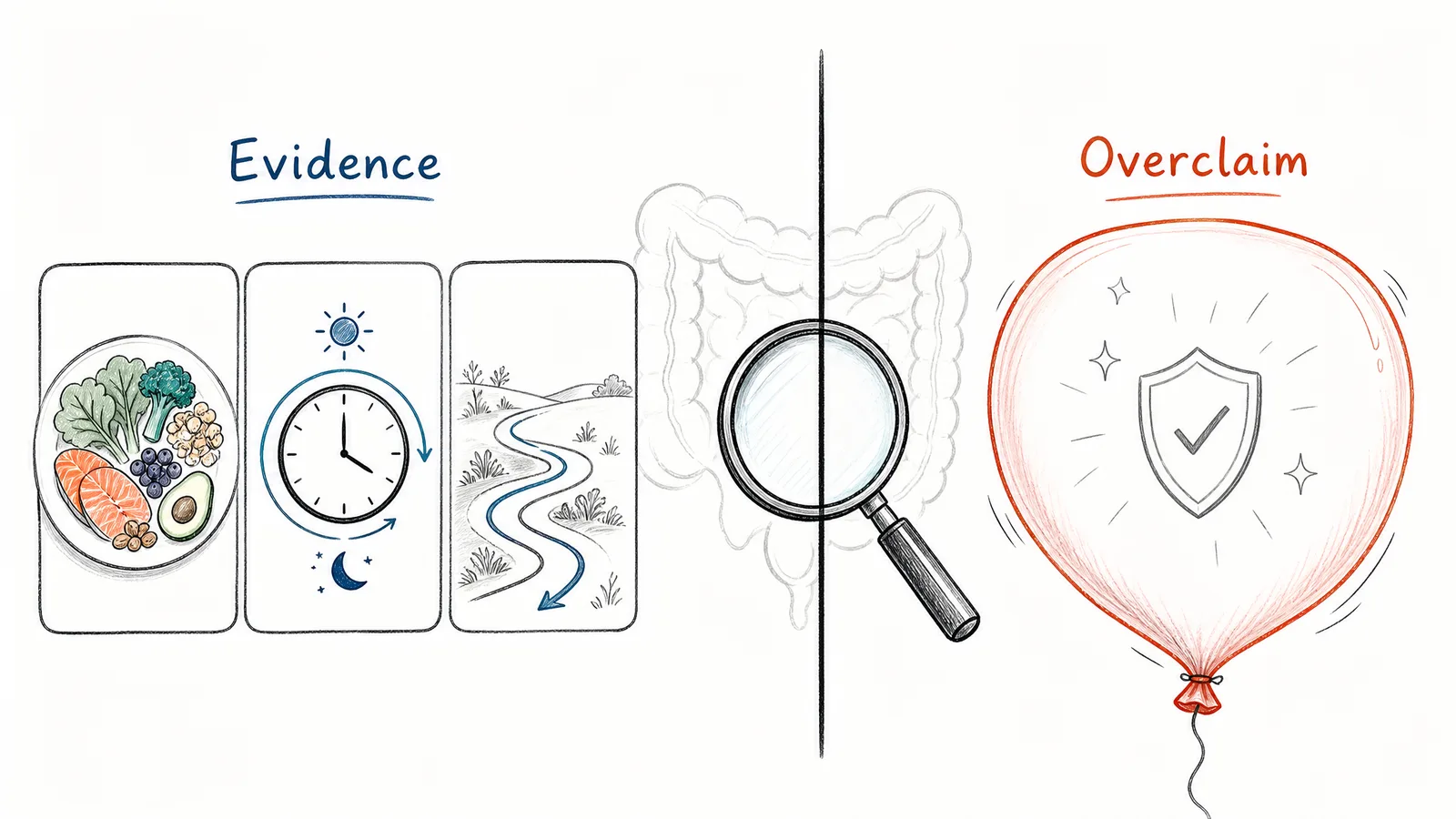
Short answer: The “3 F's” for gut health are usually framed as feeding, fluctuations, and freedom. As a memory aid, that is reasonable: diet feeds microbes, daily rhythms affect digestion, and unnecessary restriction can backfire. But the framework is not a diagnosis, a microbiome repair protocol, or proof that a stool test can personalize every gut-health decision.
What are the 3 F's for gut health?
The phrase is not a standard clinical guideline. It is a practical framework. “Feeding” points to the food substrates that reach gut microbes, especially fibers, resistant starches, and polyphenols. “Fluctuations” points to sleep, stress, meal timing, movement, travel, and other daily changes that can shift motility and symptoms. “Freedom” points to avoiding unnecessary restriction, supplement overload, and medication use without a clear indication.
That structure can help people think beyond one magic food or one probiotic. The risk is that a neat framework can sound more validated than it is. Gut health is not optimized by slogans. It is shaped by diet quality, bowel habits, medication history, infection risk, immune status, stress physiology, sleep, symptoms, and when needed, clinical testing.
Is feeding your microbiome evidence-based?
Yes, with nuance. Dietary fiber and other fermentable carbohydrates can be metabolized by gut microbes into short-chain fatty acids such as acetate, propionate, and butyrate. These metabolites can support colon-cell energy metabolism, barrier function, immune signaling, and other pathways. Human studies also show that dietary pattern can shift microbiome composition and function.
But more fiber is not automatically better for everyone at every moment. People with IBS, active bloating, strictures, severe constipation, inflammatory bowel disease flares, or recent gut surgery may need tailored advice. Increasing fermentable fiber too quickly can worsen gas, distension, or pain. The safer rule is gradual change, tolerance tracking, and clinical input when symptoms are significant.
Evidence summary
- Dietary fiber and plant diversity can support microbial fermentation, but individual tolerance varies.
- Fermented foods may influence microbiome diversity and immune markers, yet products and responses are not identical.
- Sleep, circadian timing, stress, and movement can affect gut function, but they do not diagnose dysbiosis.
- Long-term unnecessary dietary restriction may reduce diet quality and microbial substrates.
- Microbiome testing can provide a snapshot, not a stand-alone explanation for symptoms or a complete gut-health plan.
Do fluctuations like sleep and stress affect gut health?
They can. The gut has rhythmic physiology. Motility, secretions, immune tone, eating patterns, and microbial activity can vary across the day. Sleep disruption and stress can change appetite, visceral sensitivity, bowel habits, and inflammatory signaling. Exercise and regular meals can also influence motility and metabolic responses.
That does not mean every symptom after a bad night is microbiome damage. Bloating, constipation, diarrhea, reflux, or abdominal pain can fluctuate for many reasons. Stress may amplify gut sensations through the gut-brain axis, while infections, medications, food intolerances, bile acid problems, celiac disease, inflammatory bowel disease, and other conditions can produce similar symptoms. Fluctuation is a clue, not a diagnosis.
What does freedom mean for gut health?
The strongest version of “freedom” is not doing less medicine. It is avoiding unnecessary extremes. Long-term restrictive diets can reduce food variety and may reduce substrates for beneficial microbial metabolism. Unsupervised supplement stacks can add cost and side effects without clear benefit. Antibiotics, proton pump inhibitors, laxatives, NSAIDs, and other medicines can affect gut function or microbiome patterns, but they may also be necessary and beneficial when used for the right indication.
Freedom should therefore mean evidence-aware flexibility: do not restrict more than needed, do not add products just because a report flags a score, and do not stop prescribed medication without a clinician. A gut-friendly plan should make eating and bowel habits more sustainable, not more anxious.
Where does microbiome testing fit into the 3 F's?
A stool microbiome test can sometimes make the topic feel more concrete. It may show broad patterns, diversity metrics, predicted functions, or taxa associated with fiber fermentation. Used cautiously, that can support questions about diet quality and consistency. It cannot prove the root cause of symptoms, diagnose IBS or SIBO, localize a problem to the small intestine, or prescribe the exact probiotic, prebiotic, or meal plan a person needs.
The source article treats testing as a way to support personalized digestive wellness. That can be reasonable only if the limits are clear. A microbiome snapshot should be interpreted beside symptoms, medication history, diet, red flags, and standard clinical tests when indicated. Without that context, a report can turn normal biological variation into a problem to fix.
What marketing gets wrong about the 3 F's?
Marketing often turns sensible habits into a branded system. Feeding becomes a promise that more fiber will repair the gut. Fluctuations become a claim that stress or sleep explains symptoms. Freedom becomes an argument for supplement programs, repeated testing, or avoiding broad food groups. Each idea contains a useful seed, but the clinical boundary matters.
The more accurate message is simpler. Eat a diverse, tolerable, minimally processed diet. Increase fiber slowly. Include fermented foods if they suit you. Keep sleep and movement regular where possible. Avoid long-term restriction unless it has a purpose. Review medicines and supplements with a professional if symptoms are persistent. That is not flashy, but it is safer.
When should gut symptoms be checked clinically?
Do not manage red flags with a framework, supplement plan, or microbiome test. Seek medical advice for blood in stool, black stools, unexplained weight loss, persistent fever, anemia, progressive abdominal pain, nighttime diarrhea, dehydration, vomiting, new symptoms after age 50, family history of colorectal cancer or inflammatory bowel disease, or symptoms after recent antibiotics. Also seek help for severe constipation, recurrent food impaction, or symptoms that interfere with eating or daily life.
People with diabetes, kidney disease, immune suppression, pregnancy, inflammatory bowel disease, celiac disease, eating-disorder history, or complex medication regimens should be especially cautious with major diet changes.
Bottom line
The 3 F's are useful as a low-pressure reminder: feed the gut with tolerated plant diversity, respect daily rhythms, and keep enough flexibility to avoid unnecessary restriction. They are not a medical test, a diagnostic system, or a guarantee of microbiome optimization. Good gut health advice should reduce uncertainty responsibly, not replace it with a slogan.
Evidence notes
- Gill et al. (2021). Dietary fibre in gastrointestinal health and disease. Nature Reviews Gastroenterology & Hepatology. 10.1038/s41575-020-00375-4
- Martin-Gallausiaux et al. (2025). Gut microbiota-derived short-chain fatty acids and their role in human health and disease. Nature Reviews Microbiology. 10.1038/s41579-025-01183-w
- Marco et al. (2024). Fermented foods and gastrointestinal health: underlying mechanisms. Nature Reviews Gastroenterology & Hepatology. 10.1038/s41575-023-00869-x
- Wastyk et al. (2021). Gut-microbiota-targeted diets modulate human immune status. Cell. 10.1016/j.cell.2021.06.019
- Heddes et al. (2022). The intestinal clock drives the microbiome to maintain gastrointestinal homeostasis. Nature Communications. 10.1038/s41467-022-33609-x
- Staudacher and Whelan (2020). The low FODMAP diet: recent advances in understanding its mechanisms and efficacy in IBS. Nature Reviews Gastroenterology & Hepatology. 10.1038/s41575-020-0270-3
- Quigley (2017). Gut microbiome as a clinical tool in gastrointestinal disease management: are we there yet?. Nature Reviews Gastroenterology & Hepatology. 10.1038/nrgastro.2017.29
This article is educational and does not diagnose, treat, or replace care from a qualified clinician.